When planning to bring more natural light into an industrial facility, warehouse, or commercial building, most conversations focus on the panels themselves: how much light they transmit, how much energy they may help save, and how long they will last.
But there is another question that matters just as much: how do you know whether the space is actually receiving the amount of light it needs? The answer fits in the palm of your hand: a lux meter.
What is a lux meter?
A lux meter is a portable instrument used to measure illuminance, or the amount of light reaching a surface. The reading is expressed in lux, a unit equal to one lumen per square meter.
In practical terms, a lux meter does not measure how bright a lamp or window appears. Instead, it measures how much usable light actually reaches a desk, production line, warehouse aisle, or other working surface.
Most models follow a similar design: a photosensitive sensor detects the light, while a digital display shows the reading. Some professional devices include data logging capabilities, while simpler models are suitable for quick jobsite evaluations.
If you work with foot-candles, the conversion is straightforward: one foot-candle equals approximately 10.76 lux.
Why does a lux meter matter in daylighting projects?
Natural light is constantly changing. It varies according to the time of day, season, cloud cover, and building orientation. The human eye adapts so effectively to these changes that visual perception alone is not a reliable way to evaluate lighting conditions.
A space may feel well lit in the morning but receive insufficient daylight later in the afternoon. One part of a warehouse may appear bright while another area only a few yards away is noticeably darker.
A lux meter turns those impressions into measurable data.
For architects, engineers, and facility teams, this provides three practical advantages:
- Baseline assessment: Identify areas with insufficient light before making changes and determine where translucent panels may be most effective.
- Post-installation validation: Compare readings before and after the project to determine whether daylight levels actually improved.
- Measurable results: Provide management teams, clients, or inspectors with onsite measurements rather than relying solely on product specifications or visual impressions.
How to measure natural light step by step
You do not need to be a lighting specialist to obtain useful readings, but consistency is important.
- Define the work plane. Measure light at the height where the activity takes place. In offices, this is typically desk height. In warehouses or industrial spaces, measurements may be taken at floor level or at shelving height, depending on the task.
- Create a measurement grid. Take readings at several points throughout the space instead of relying on a single measurement. This helps identify darker areas and shows how evenly daylight is distributed.
- Keep conditions in mind. Repeat measurements at different times of day and record whether conditions were sunny or cloudy. When comparing before-and-after results, try to measure under similar conditions.
- Avoid casting shadows on the sensor. Keep your body and nearby objects away from the sensor and maintain the same orientation for each reading.
- Record the results. Note the lux reading, time, weather conditions, and exact measurement location. This record becomes the basis for meaningful comparisons.
What lux levels should you look for?
Recommended lux levels depend on the activity taking place in the space.
A circulation area generally requires much less light than an inspection or assembly area. As a broad reference, offices commonly target several hundred lux, while warehouses and storage areas may operate at lower levels.
The most appropriate approach is to review local regulations and the specific lighting criteria for the project, then use the lux meter to determine whether natural daylight reaches those targets during operating hours.
Where do acrylic panels fit in?
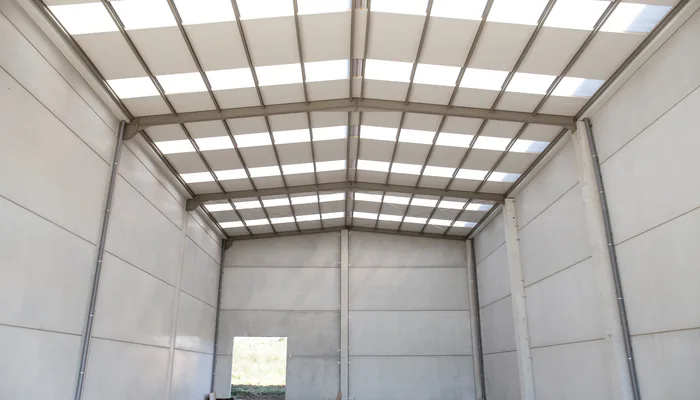
Once baseline readings have been taken, the next question is how to improve areas where daylight levels fall short. This is where acrylic panels can become an option for roofs and walls in industrial, commercial, and architectural buildings.
These translucent panels are manufactured with 100% acrylic resin and are designed to bring natural daylight into interior spaces. Their characteristics include UV protection, double-sided gel coat protection, impact resistance, and resistance to yellowing and delamination.
They also take advantage of diffused light. Instead of concentrating sunlight in a single area, the panels distribute it more evenly throughout the space.
A lux meter makes this effect measurable. By taking readings at different locations, you can see whether light distribution becomes more consistent after the panels are installed.
That is especially useful when evaluating the outcome of a daylighting project: measure first, install the panels, measure again, and compare the results using actual onsite data.
Other translucent options for your project
Every building has different requirements, so comparing materials before making a final decision can be worthwhile.
If your project involves translucent roofing with another type of material, twinwall polycarbonate panels are another option to consider.
Regardless of which panel system is selected, the measurement process remains the same. Using the same method makes it easier to evaluate different daylighting solutions against consistent criteria.
Measure before you decide
A lux meter does not replace the expertise of an engineer or architect, but it provides something visual judgment alone cannot: real measurements from the building itself.
With a clear baseline, selecting a daylighting solution becomes less dependent on assumptions and more informed by actual conditions.
Frequently Asked Questions
Do I need a professional lux meter?
For a quick assessment, a basic portable lux meter is usually sufficient. If the project requires formal reporting, a calibrated instrument with data logging capabilities may be more appropriate.
When is the best time to measure light levels?
Ideally, take measurements at several times throughout the day. For before-and-after comparisons, use similar weather and daylight conditions whenever possible.
Can I use a smartphone as a lux meter?
Lux meter apps are available, but accuracy can vary significantly between devices. For project decisions, a dedicated measuring instrument is preferable.
Can Acrylic Panels be used on both roofs and walls?
They are intended for roof and wall applications in industrial, commercial, and architectural buildings. The appropriate configuration should be selected according to the specific project requirements.

Stabilit America Inc. is a leading North American manufacturer of fiberglass reinforced panels (FRP) and polycarbonate sheets, with over 65 years of experience. The company offers the widest range of acrylic, polyester, and polycarbonate laminates, backed by international certifications (USDA, Greenguard, FM, ISO 9001, among others), serving industries such as industrial construction, transportation, and sustainable building.