Agricultural buildings work under pressure every day. Moisture, animal waste, fertilizers, temperature changes, cleaning routines, and constant equipment movement create conditions that quickly expose weak materials. A barn, greenhouse, warehouse, or livestock facility cannot depend on surfaces that rust, rot, absorb moisture, or demand constant repairs.
That is why Opalit Agroindustrial panels have become a smart material choice for farm infrastructure. Designed for agricultural environments, they combine durability, resistance, and low-maintenance performance in facilities exposed to humidity, weather changes, cleaning routines, and daily operational wear.
For owners, contractors, and agricultural operators, the value is clear: stronger buildings, cleaner surfaces, and fewer interruptions to daily operations.
Why agricultural buildings need tougher panel systems
Farm facilities are not ordinary buildings. They face high humidity, chemical exposure, frequent washdowns, ammonia, dust, animal contact, and harsh weather.
In these environments, material selection directly affects long-term performance. A wall or roof panel is not just part of the structure; it supports hygiene, workflow, asset protection, and operational continuity. When panels fail, the problem is rarely cosmetic. It can mean leaks, contamination risk, downtime, and avoidable replacement costs.
What makes FRP panels a strong fit for agriculture?
Fiber reinforced polymer, or FRP, is a composite material designed to offer strength without the weaknesses commonly associated with metal or wood.
Moisture and corrosion resistance
Moisture is one of the biggest enemies of agricultural infrastructure. Condensation, washdowns, leaks, and humidity can gradually damage traditional materials. Metal may corrode. Wood may rot. Some surfaces may absorb moisture and become harder to clean.
Improved environment and limited heat gain
FRP roof panels absorb less heat than comparable metal panels, helping create a cooler environment in animal confinement facilities. Compared with metal, FRP can remain up to 10% cooler at the roof surface, contributing to a more comfortable space for livestock.
Low maintenance for demanding routines
Agricultural teams do not need one more maintenance task on the list. There are animals to care for, crops to manage, equipment to maintain, and operations to keep moving. Panels that require frequent coating, patching, or replacement become a hidden cost.
FRP panels are valued because they can be sprayed clean and maintained with less effort. Their low-porosity surface helps prevent debris and dirt from penetrating the substrate, which supports easier cleaning and upkeep.
Better hygiene for barns, livestock areas, and processing spaces
Cleanability is a serious performance factor in agricultural buildings. In livestock barns, dairy facilities, poultry sheds, and food-adjacent areas, surfaces must support regular cleaning without degrading quickly.
Smooth FRP panels are especially relevant because they are used in barns, warehouses, and agricultural processing plants where moisture, ammonia exposure, and temperature fluctuations are common.
This is where FRP in agricultural projects becomes more than a construction upgrade. It becomes a practical way to support cleaner interiors, better workflow, and longer-lasting farm infrastructure.
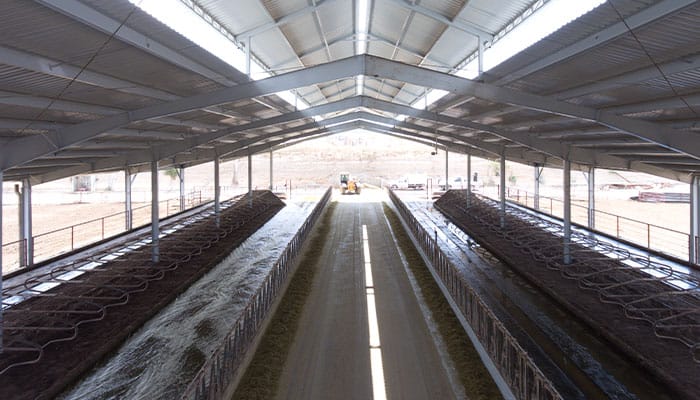
Applications for FRP agricultural building panels
Free-stall buildings
Free-stall buildings expose roofing materials to ammonia fumes, animal waste, humidity, and other corrosive conditions. In these environments, light-gauge metal panels may require regular maintenance and patching as corrosion develops over time.
FRP roof panels provide a durable alternative because they will not rot, rust, or corrode. Their resistance to demanding livestock environments can reduce maintenance requirements while helping preserve the roof’s performance throughout the building’s service life.
Livestock barns and poultry facilities
Livestock buildings are exposed to ammonia, moisture, waste, impact, and frequent cleaning. FRP panels can help protect interior walls and roofing areas by resisting corrosion and providing surfaces that are easier to clean.
Greenhouses and propagation buildings
Greenhouses require material systems that support environmental control, light management, and long-term durability.
Feed, grain, and equipment storage
Storage areas need protection from moisture, dust, impact, and chemical exposure. Agricultural cladding is commonly used in storage and handling facilities for feed and grain, as well as equipment sheds and workshops.
Processing and packing areas
Agricultural processing environments require durable surfaces that can handle cleaning routines and operational traffic. Smooth, nonporous cladding surfaces can be easier to clean and help reduce buildup of bacteria, mold, and contaminants.
Performance advantages over traditional materials
Different building materials can perform well depending on the application, but agricultural facilities require panels specifically engineered for constant exposure to humidity, weather changes, cleaning routines, and corrosive farm conditions.
Opalit Agroindustrial FRP panels from Stabilit America are designed for these conditions, combining the lightweight performance of fiberglass reinforced polymer with durability, corrosion resistance, and low-maintenance value for roofing, siding, wall, and ceiling applications.
Rather than treating the panel as a basic surface, Opalit Agroindustrial positions it as part of the building’s performance strategy. In farm infrastructure, the right panel can help maintain cleaner surfaces, support easier maintenance, and contribute to lifecycle value in facilities exposed to animal waste, byproducts, industrial conditions, and wet or humid settings.
Built for harsh daily exposure
Farm buildings and trellising systems face severe weather, fertilizers, pesticides, humidity, and gases such as ammonia in poultry and hog farm environments. Opalit Agroindustrial panels are engineered to withstand these demanding agricultural exposures while supporting easy cleaning and low-maintenance performance.
That matters because agricultural infrastructure cannot be evaluated only by upfront cost. The smarter metric is total lifecycle value. A panel that lasts longer, cleans more easily, and resists damage can reduce repair frequency and help protect the building investment over time.
How FRP supports operational efficiency
Every repair, shutdown, or replacement pulls attention away from core operations. FRP panels help reduce that friction by combining durability with practical installation and maintenance benefits.
In short, the panel does more than cover a wall or roof. It helps the facility perform better. Not very glamorous, perhaps, but neither is replacing corroded panels during peak season. That is the kind of operational headache nobody puts in the annual plan.
Choosing the right panels for your agricultural project
Before selecting FRP panels, project teams should evaluate the building’s environment and daily use. A livestock barn, greenhouse, compost area, and equipment shed may all need different levels of impact resistance, light transmission, finish, thickness, and chemical resistance.
Key questions to consider include:
- Will the building face constant humidity or washdowns?
- Is ammonia or fertilizer exposure expected?
- Does the space need easy-to-clean wall surfaces?
- Is natural light transmission important?
- Will panels be used for roofing, cladding, or interior lining?
- Is the project new construction or a retrofit?
- What level of impact resistance is required?
Stabilit offers covering and cladding solutions ranging from light-transmitting coverings to opaque roofing systems for agricultural buildings, which allows project teams to match the material to the actual use case.
For more information about product categories, applications, and technical support, agricultural project teams can visit https://www.stabilitamerica.com/.
A stronger material decision for long-term farm performance
FRP agricultural building panels are not just another construction material. They are a response to the real conditions farms deal with every day: humidity, corrosion, animal waste, cleaning, impact, and weather exposure.
For barns, greenhouses, warehouses, livestock areas, and processing spaces, FRP can help create more durable, cleaner, and lower-maintenance facilities. The right panel system protects the structure, supports daily operations, and reduces the constant cycle of repair and replacement.
In agriculture, performance is not theoretical. It is measured in buildings that stay functional, surfaces that clean faster, and operations that keep moving. FRP panels fit that reality with a practical value proposition: strong materials for hard-working environments.
Sources consulted:
- https://www.creativecompositesgroup.com/industries-products/building-architecture-solutions/fiberglass-agricultural-building-panels
- https://www.strongwell.com/news/ten-places-to-use-structural-fiberglass-in-farm-operations/
- https://www.re-thinkingthefuture.com/technologies/why-frp-panels-are-transforming-agricultural-infrastructure-and-biosecurity-standards-across-north-america-in-2026/#google_vignette

Stabilit America Inc. is a leading North American manufacturer of fiberglass reinforced panels (FRP) and polycarbonate sheets, with over 65 years of experience. The company offers the widest range of acrylic, polyester, and polycarbonate laminates, backed by international certifications (USDA, Greenguard, FM, ISO 9001, among others), serving industries such as industrial construction, transportation, and sustainable building.