When it is time to choose a material for a skylight, partition, or enclosure, one question often comes up: polycarbonate or PVC? Both may look like suitable options on paper, and both can deliver good performance, but they are designed to address different project needs.
This guide explains the main differences in simple terms and looks at the types of projects where each material may make more sense, helping you make a more informed decision.
What really sets polycarbonate apart from PVC?
Although the two materials may look similar at first glance, their differences become clearer when you consider what your project actually requires. Four criteria are particularly important:
- Transparency: If your project requires clear light transmission, solid polycarbonate offers an appearance similar to glass. Rigid PVC, in general, is more commonly used in applications where optical clarity is not the main priority.
- Impact resistance: Polycarbonate is recognized as one of the most impact-resistant engineering polymers and maintains this performance across a broad temperature range.
- Sun exposure: A sheet with properly designed UV protection can make a significant difference in exterior applications where solar radiation is constant.
- Versatility: The ability to cut, curve, and adapt the material on site can help reduce installation time and material waste.
If you want a better understanding of what the material is made of and why it performs the way it does, polycarbonate plastic provides useful background for this comparison.
When is solid polycarbonate the better choice?
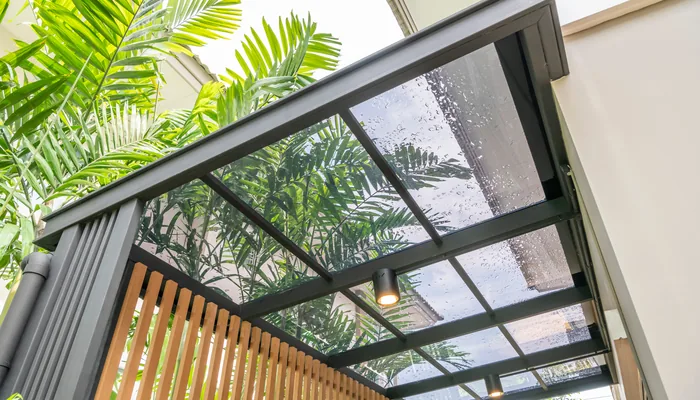
If a project combines natural light, safety, and exterior exposure, solid polycarbonate can be a strong option to consider. It is particularly relevant when translucent is essential and the project calls for higher performance than some alternative materials can provide.
Common applications include:
- Skylights and glazing
- Operable architectural elements
- Exterior partitions
- Noise barriers
- Safety glazing
- Parapets
For these applications, Macrolux Solid Panels are designed for demanding projects, combining light weight, good light transmission, and the versatility needed for easier jobsite handling.
Macrolux Solid: Design flexibility through cold bending
One of the key advantages of Macrolux Solid is its ability to be cold-bent without the need for thermal pretreatment. This feature provides architects and designers with greater freedom to create curved surfaces and innovative architectural applications.
Its flexibility makes it suitable for a variety of applications, including:
- Domes and barrel vaults.
- Tunnels and covered walkways.
- Canopies and curved roofing.
- Curved architectural elements.
- Skylights and other custom glazing applications.
Cold bending allows the material to adapt to different design requirements while simplifying the fabrication process and eliminating the need for additional heating equipment.
When properly designed and installed, curved polycarbonate sheets offer an effective solution for combining architectural aesthetics, durability, and design versatility.
An important consideration during installation is the material’s natural thermal expansion and contraction. Proper allowances must be incorporated into the design to accommodate temperature-related movement and ensure long-term performance.
Looking for an opaque sheet solution?
Not every project requires transparency. For applications where an opaque solution is preferred, FRP (Fiberglass Reinforced Plastic) sheets offer an excellent combination of strength, durability, and versatility.
Reinforced with fiberglass, FRP sheets provide enhanced mechanical resistance and excellent corrosion resistance, making them suitable for demanding environments and a wide range of applications.
From residential and industrial projects to agricultural and agro-industrial facilities, FRP sheets offer a durable solution designed to withstand challenging conditions and deliver long-term performance.
Whether your project calls for transparent, translucent, or opaque materials, we offer solutions designed to meet different performance and application requirements.
Choose with confidence: Your project deserves the right material
Comparing materials is the first step. Selecting the appropriate solution for the actual project is the next.
If you are deciding between materials for a skylight, enclosure, partition, or other architectural application, the Stabilit America team can help determine the appropriate thickness, dimensions, and finish for Macrolux Solid sheets.
Contact Stabilit America for recommendations tailored to your project.
Frequently Asked Questions
Can Macrolux Solid sheets be curved?
Yes. Macrolux Solid can be cold curved as long as the minimum bending radius for the selected sheet thickness is respected.
What thicknesses are available for Macrolux Solid panels?
Macrolux Solid is available in 3, 4.5, 6, 9.5, and 12.7 mm thicknesses. Color availability should be confirmed with the Stabilit America team.
Do Macrolux panels include a warranty?
UV-protected sheets carry a 10-year warranty against yellowing, loss of light transmission, and breakage caused by hail. Exact warranty terms should be confirmed with the sales office.

Stabilit America Inc. is a leading North American manufacturer of fiberglass reinforced panels (FRP) and polycarbonate sheets, with over 65 years of experience. The company offers the widest range of acrylic, polyester, and polycarbonate laminates, backed by international certifications (USDA, Greenguard, FM, ISO 9001, among others), serving industries such as industrial construction, transportation, and sustainable building.