Fiberglass shows up everywhere — in buildings, vehicles, boats, food plants and even theme parks. But is fiberglass a composite, a polymer or something else entirely? Understanding that answer is key if you’re evaluating materials for a project, especially in construction, industrial applications or infrastructure.
In this guide, we’ll explain why fiberglass is considered a composite material, how it’s made, what it’s used for and how it compares to other composites. We’ll also add practical, real-world insights so you can make confident decisions about using fiberglass in your facility or project.
What Is a Composite Material?
Composite materials are combinations of two or more distinct components that remain separate at the microscopic level but work together as a single, engineered material. The components have different chemical and physical properties, and when you combine them, you get a product with enhanced performance compared to each one on its own.
In most composites you’ll find:
- Matrix: The continuous phase (often a polymer or resin) that holds everything together.
- Reinforcement: The stronger phase (fibers, particles or fabrics) that provides most of the mechanical strength.
Each component contributes its best properties — strength, stiffness, chemical resistance, flexibility, etc. — creating a specialized material designed for a particular job.
Common Examples of Composite Materials
- Engineered wood:
Materials like plywood and particleboard combine real wood with adhesives. The result is more dimensionally stable and durable than a single piece of lumber and can be engineered with features like water resistance.
- Reinforced concrete:
Concrete (strong in compression) is combined with steel bars (strong in tension), creating a composite that’s ideal for buildings, bridges and heavy infrastructure.
- Plastic-coated paper:
Paper combined with a plastic film forms a tougher, moisture-resistant material. Playing cards are a classic example.
- Reinforced plastics (fiber-reinforced polymers):
A polymer matrix combined with fibers of glass, carbon or aramid. These fiber-reinforced composites are widely used in aerospace, automotive and construction.
From a material science perspective, when we ask “is fiberglass a composite?”, the answer fits exactly into this definition: it’s a fiber-reinforced polymer where glass fibers strengthen a polymer resin.
How Are Composites Formed?
Composites can be manufactured using different techniques depending on the desired thickness, shape, performance and production volume. Some of the most common methods include:
Compression Molding
- A measured amount of reinforcement and resin is placed into a preheated mold.
- The mold is closed and held under pressure until the resin cures.
- This process offers consistent thickness and is suitable for medium to high production volumes.
Injection Molding
- The resin, often pre-mixed with short fibers, is injected into a closed mold under high pressure.
- It’s ideal for complex shapes and smaller components that require tight tolerances.
Wet Lay-Up
- Dry reinforcement (such as fiberglass fabric or mat) is laid into an open mold.
- Resin is manually applied and rolled to remove air bubbles.
- Additional layers are built up until the desired thickness is reached and the laminate is allowed to cure.
- This is common in boat building and custom parts.
Other Methods (for Advanced Composites)
- Pultrusion: Continuous process for making constant cross-section profiles like beams and channels.
- Resin transfer molding (RTM): Dry fibers are placed in a mold, then resin is injected under pressure.
- Filament winding: Fibers are wound around a mandrel and impregnated with resin, ideal for pipes and tanks.
Regardless of the method, quality composite manufacturers follow strict curing, inspection and testing protocols to ensure consistent strength, thickness and performance.
Benefits of Composites
Composites are used in everything from electrical equipment and aerospace components to wall panels and walkways. People choose composites over traditional materials for several key reasons:
Cost-Efficiency
- Composites can deliver high strength at a lower weight, which is often more economical than metals on a performance-per-weight basis.
- Processes like molding minimize off-cuts and waste.
- Lighter materials can reduce transportation costs and improve energy efficiency (for example, lighter vehicles with better fuel economy).
Versatility
- Composites can be engineered for specific applications — high stiffness, chemical resistance, electrical insulation, impact resistance and more.
- They can be molded into complex shapes that would be difficult or expensive with metals or concrete.
- Surface finishes, colors and textures can often be integrated directly into the material.
Durability
- Many composites are highly resistant to fatigue, impact and harsh environmental conditions.
- They do not rust like steel or rot like wood.
- With proper design and installation, composites can deliver long service life with minimal maintenance.
Additional Enhanced Capabilities
Composites can also offer:
- Corrosion resistance to chemicals, moisture and salt environments.
- Electrical insulation, making them ideal for power systems and electrical housings.
- Fire resistance when combined with the right additives and resins.
- Waterproofing or low water absorption, depending on the formulation.
These characteristics are exactly why fiberglass composite panels are widely used in agricultural buildings, industrial plants, food-processing areas and commercial facilities.
History of Composites
The concept behind composites is surprisingly old. Humans have been combining materials to improve performance for thousands of years.
Ancient Times
- Around 3400 B.C., Mesopotamians created early versions of plywood by gluing wood layers at different angles, finding that this structure was more robust than solid wood.
- Egyptians and Mesopotamians also mixed straw with mud or pottery to increase strength and reduce cracking.
- Throughout ancient civilizations, builders and artisans used natural composites to improve durability and performance.
Early to Mid-1900s
- In 1907, Dr. Leo Baekeland created the first fully synthetic plastic (Bakelite), which was soon combined with fillers and reinforcements to form early composites.
- In 1920, Hermann Staudinger demonstrated the existence of polymers, laying the foundation for modern polymer science.
- A major milestone came in 1954 with the Chevrolet Corvette, whose body used fiberglass-reinforced plastic, making it lighter and more corrosion resistant than traditional designs.
Late 1900s to 2000s
- Composites gained widespread use in utility poles, insulators, construction, boats, sporting goods, wind turbine blades and more.
- The focus gradually shifted toward materials that are lighter, more durable and more environmentally friendly, with efforts to increase recyclability and reduce emissions in production.
The Birth of Fiberglass
Fiberglass itself was first developed as “glass wool” in the early 1900s by Games Slayter. Improvements in manufacturing allowed glass fibers to be produced more consistently and in greater volumes, eventually leading to the wide range of fiberglass composite products we see today.
What Is Fiberglass Made Of?
Fiberglass is produced by combining:
- Glass fibers (the reinforcement)
- Polyester resins or other polymer resins (the matrix)
The glass is melted and drawn into fine fibers, which are then:
- Flattened into sheets,
- Woven into fabrics,
- Or formed into mats or continuous rovings.
These fibers are then impregnated with resin. Once cured, the resin holds the fibers in place and transfers load between them.
You can also tailor the properties of a fiberglass composite by adjusting:
- The resin type (e.g., general-purpose polyester vs. vinyl ester for enhanced corrosion resistance)
- The fiber orientation (woven, chopped strand mat, continuous rovings)
- The thickness and layer sequence
In many ways, fiberglass behaves like traditional glass in that it:
- Does not absorb moisture
- Does not rust
- Maintains dimensional stability over time
But thanks to the resin matrix and fiber architecture, fiberglass becomes malleable, strong and easier to shape into useful forms like panels, tanks, boats, tubs and custom profiles. Manufacturers can also apply an additional gel coat to improve UV resistance, surface finish and cleanability.
Types of Fiberglass
Fiberglass comes in several chemical formulations and physical forms, each optimized for different operating conditions.
Major Fiberglass Types (by Composition)
- A-glass (alkali glass):
- Similar to window glass.
- Offers good chemical resistance at a relatively low cost.
- Used in processing equipment and in many food containers, jars and bottles.
- C-glass (chemical glass):
- Designed for maximum chemical resistance.
- Commonly used in the outer layers of pipes, tanks and equipment that face aggressive chemical environments.
- E-glass (electrical glass):
- Lightweight and excellent for electrical insulation.
- Handles elevated temperatures and maintains strength in demanding conditions.
- Widely used in aerospace, marine and industrial applications.
- S-glass (structural glass):
- Offers very high tensile strength and excellent acid resistance.
- Used primarily in defense, aerospace and high-performance sporting goods.
- More expensive and produced in lower volumes than E-glass.
Physical Forms of Fiberglass
- Fiberglass tape:
Made from glass fiber yarns, tape provides excellent thermal insulation and local reinforcement. It’s common for repairing seams, reinforcing corners and sealing joints (for example, in drywall, boats and tanks). - Fiberglass cloth:
Smooth and flexible, typically used in heat shielding, fire curtains and precision laminates where a clean surface and high strength are required. - Fiberglass rope:
Created by braiding glass yarns into a rope structure. It’s used for packing, gasketing and sealing applications that require thermal resistance and dimensional stability.
All of these variations support one central concept: fiberglass is a composite whose properties can be tuned by changing fiber type, orientation, resin, and layup.
Is Fiberglass a Composite or a Polymer?
This is the key question: Is fiberglass a composite or just a polymer?
Short Answer: Fiberglass Is a Composite
Fiberglass is not simply a polymer. It is a composite material made from:
- Glass fibers (reinforcement)
Polyester or other resin (polymer matrix)
The polymer alone would be too flexible or weak for many structural uses, and the glass alone would be brittle and difficult to shape. When combined:
- The glass fibers provide tensile strength and stiffness.
- The resin binds everything together, transfers loads and protects the fibers.
This combination creates a fiberglass composite with properties that neither material has alone:
- High strength-to-weight ratio
- Excellent electrical insulation
- Resistance to moisture, rust and many chemicals
So, when someone asks “is fiberglass a composite or polymer?”, the technically accurate answer is:
Fiberglass is a fiber-reinforced composite material consisting of glass fibers embedded in a polymer resin.
What Is Fiberglass Used For?
The versatility of fiberglass composites makes them a go-to material in many industries. Their durability, thermal insulation and design flexibility are ideal wherever strength and longevity matter.
Manufacturing & Industrial Facilities
- Machine guards, covers and housings that need electrical insulation and impact resistance.
- Grating, ladders, platforms and railings that provide slip resistance in wet or oily areas.
- Components that need to perform under chemically aggressive or humid conditions.
Automotive Industry
- Structural and semi-structural parts such as bumpers, hoods, body kits and interior panels.
- Components like timing belt covers and underbody panels where corrosion resistance and weight reduction are required.
- Fiberglass helps manufacturers reduce vehicle weight, improving fuel efficiency without sacrificing strength.
Pulp and Paper
- Walkways, grating and structural supports in pulping and bleaching areas where chemicals can quickly damage traditional metals.
- Components in stock preparation and paper machines that must resist constant moisture and chemical exposure.
Food and Beverage Industries
- Food storage containers such as jars and bottles (A-glass) that protect contents from chemical interaction.
- Fiberglass-reinforced plastic (FRP) panels in processing areas, cold rooms and wash-down spaces where hygiene, corrosion resistance and easy cleaning are critical.
- Non-slip grating and platforms in wet production zones.
Fountains, Aquariums and Water Features
- Structural supports and grating in tanks and filtration systems.
- Components that need to withstand continuous water contact, disinfectants and cleaning chemicals.
- Fixtures like light housings and sprayer supports that must avoid rust and degradation.
These real-world applications underline why fiberglass composite materials have become a standard choice where performance, durability and safety are paramount.
Benefits of Fiberglass
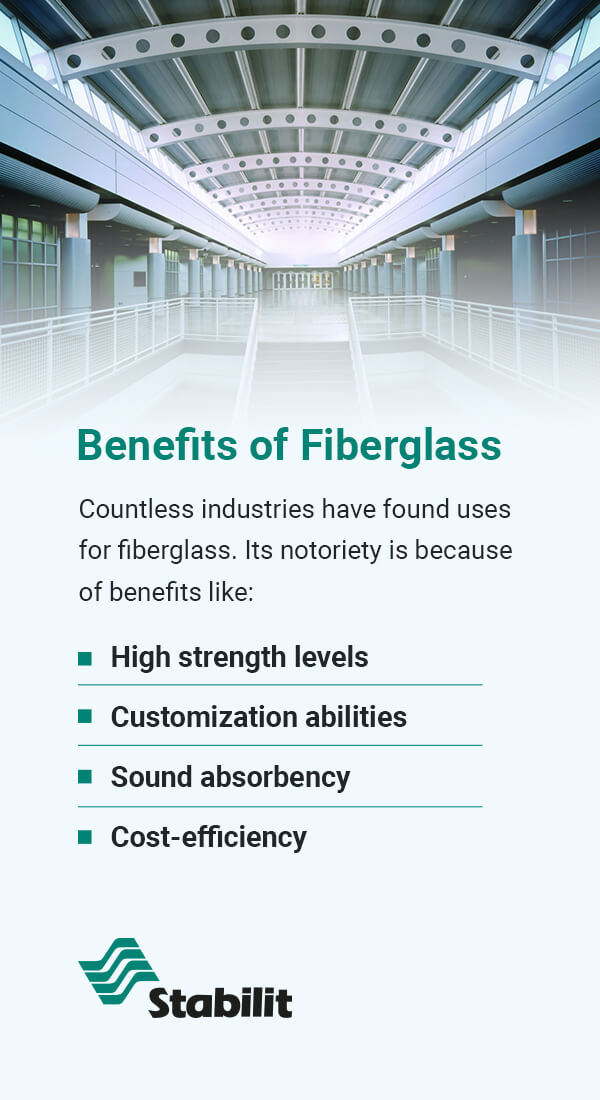
Fiberglass is one of the most widely used composite materials because it offers a powerful combination of advantages.
High Strength and Long-Term Performance
- Fiberglass does not rust, corrode or rot.
- It maintains its mechanical properties in harsh environments, including exposure to moisture, chemicals and temperature swings.
- Properly designed fiberglass composite systems can remain in service for decades with minimal degradation.
Customization and Design Flexibility
- Fiberglass can be molded into complex shapes, making it ideal for both standard panels and custom parts.
- Different resins, glass types and layups can be chosen for specific needs — impact resistance, flame retardance, food-grade, UV resistance and more.
- This flexibility reduces the need for secondary fabrication and finishing, saving time and labor.
Thermal and Acoustic Properties
- Fiberglass has good thermal insulation, helping stabilize temperatures in controlled environments.
- It can also provide sound absorption, reducing noise from machinery and equipment to help protect workers’ hearing.
Low Maintenance and Life-Cycle Cost
- Fiberglass composite systems typically require less maintenance than steel or wood.
- Their long service life and resistance to corrosion reduce the need for frequent repairs or replacements.
In many applications, the total life-cycle cost of fiberglass is lower than that of traditional materials, even if initial purchase costs are comparable.
Beef up Your Building With Fiberglass Panels From Stabilit America
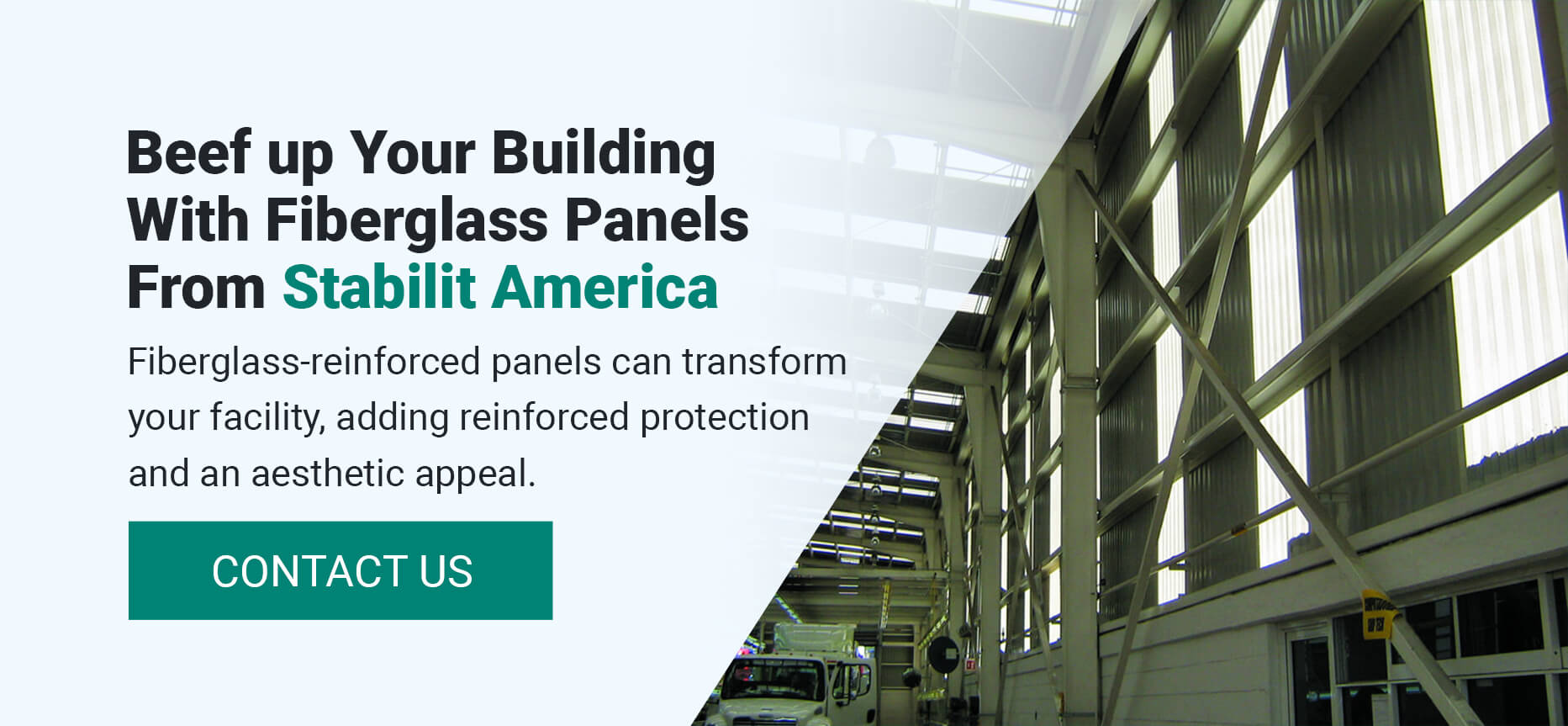
Fiberglass is one of the most proven and versatile composite materials available today. Its strength, durability, corrosion resistance and design flexibility make it a smart choice for:
- Industrial and manufacturing facilities
- Food and beverage plants
- Agricultural buildings
- Commercial and residential projects
- Water treatment, aquariums and specialized environments
At Stabilit America, we focus on fiberglass-reinforced plastic (FRP) panels engineered to perform in demanding real-world conditions. Our fiberglass composite solutions include:
- Roofing panels that stand up to UV exposure, weather and corrosive atmospheres
- Siding and cladding panels for long-lasting building envelopes
- Liner panels that make interior spaces easier to clean and maintain
Our team can help you evaluate whether fiberglass composite panels are the right solution for your specific application, balancing performance, budget and regulatory requirements.
To get started with Stabilit America, browse our fiberglass-reinforced plastic panel products, explore how they’ve been used in facilities like yours, and contact us to discuss your next project. Fiberglass composites could be the key to making your building stronger, safer and more durable for years to come.
FAQs About Fiberglass Composites
To reinforce the key concepts and address common concerns, here are some frequently asked questions about fiberglass composite materials.
1. Is fiberglass a composite or a polymer?
Fiberglass is a composite material, not just a polymer. It consists of glass fibers (the reinforcement) embedded in a polymer resin (the matrix). This combination is what gives fiberglass its excellent strength, stiffness and durability. When people ask, “is fiberglass a composite or a polymer?”, the correct technical answer is that it is a fiber-reinforced composite based on a polymer matrix.
2. Is fiberglass stronger than steel?
Fiberglass is not stronger than steel in every scenario, but it has a very high strength-to-weight ratio. Per unit of weight, many fiberglass composites can rival or exceed the performance of steel while:
- Being much lighter
- Offering superior corrosion resistance
- Reducing the need for coatings and maintenance
This is why fiberglass composite panels are often preferred in corrosive or weight-sensitive applications, even if steel may have higher absolute strength.
3. Is fiberglass a composite material suitable for food-processing environments?
Yes — when designed correctly, fiberglass composite panels are an excellent choice for food and beverage facilities. Their benefits include:
- Smooth, cleanable surfaces
- Resistance to moisture, cleaning chemicals and disinfectants
- Non-corroding surfaces that help maintain hygiene
- Compatibility with wash-down procedures
Always confirm that the specific fiberglass product meets relevant industry standards and hygiene requirements for your application.
4. How long do fiberglass composite panels last?
Service life depends on the environment and application, but fiberglass composites are known for their longevity. With proper design, installation and maintenance, fiberglass panels can perform for 20–30 years or more, especially in building envelope and interior applications. Their resistance to rust, rot and many chemicals significantly extends their functional lifespan compared to many traditional materials.
5. Is fiberglass a composite that’s safe to work with?
Yes, fiberglass is generally safe to handle when proper precautions are taken:
- Use appropriate personal protective equipment (PPE) — gloves, long sleeves, eye protection and a dust mask or respirator when cutting or sanding.
- Follow the manufacturer’s safety data sheets (SDS) for instructions on handling, cutting and installing fiberglass composite materials.
Once installed and fully cured, fiberglass composite panels are stable, non-rusting and low maintenance, contributing to a safer and cleaner environment for workers and occupants.
6. Can fiberglass composites be used outdoors?
Absolutely. Many fiberglass composite systems are specifically engineered for outdoor use, such as:
- Agricultural and industrial roofing
- Exterior cladding and siding
- Walkways and platforms in chemical and coastal environments
When choosing outdoor fiberglass solutions, look for products with UV-stable resins and protective gel coats to maintain color, appearance and performance over time.

Stabilit America Inc. is a leading North American manufacturer of fiberglass reinforced panels (FRP) and polycarbonate sheets, with over 65 years of experience. The company offers the widest range of acrylic, polyester, and polycarbonate laminates, backed by international certifications (USDA, Greenguard, FM, ISO 9001, among others), serving industries such as industrial construction, transportation, and sustainable building.