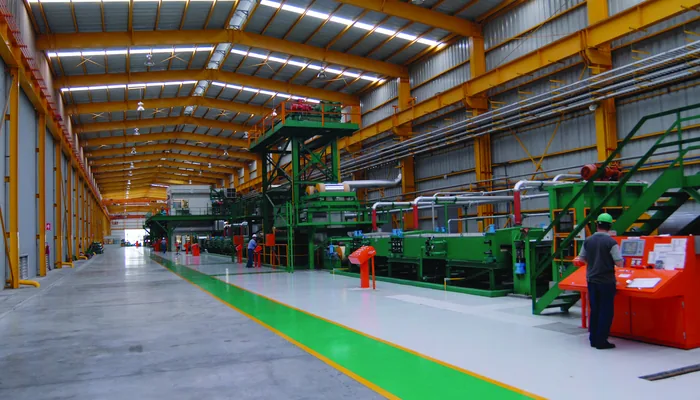
Lighting is a major operational consideration for industrial facilities. Warehouses, manufacturing plants, distribution centers, and other large buildings often depend heavily on artificial lighting because their size and layout limit access to daylight.
Incorporating natural light into an industrial building can help reduce reliance on electric lighting while creating brighter and more comfortable work areas. One way to achieve this is through translucent roof and wall systems that allow daylight to enter and distribute across interior spaces.
Acrylit is designed for this type of application. Made with acrylic resin reinforced with fiberglass, these translucent panels combine light transmission, high light diffusion, UV protection, and durability for demanding industrial environments.
Why does natural light matter in industrial buildings?
Large industrial facilities can require extensive lighting throughout the workday. When daylight is not effectively incorporated into the building design, artificial lighting may remain in use even when sufficient sunlight is available outdoors.
A natural light industrial building strategy can help address this challenge by incorporating translucent materials into selected areas of the roof or walls. The objective isn’t necessarily to eliminate artificial lighting, but to reduce its use when daylight conditions are favorable.
Better daylight distribution can also improve visibility in work areas, helping create a more comfortable and functional environment for employees.
How do Acrylit panels work?
Acrylit is a translucent fiberglass-reinforced panel designed to bring natural daylight into industrial buildings while distributing that light throughout the interior.
One of its key characteristics is its high level of light diffusion. Acrylit can achieve approximately 90-95% haze, helping scatter incoming daylight rather than allowing it to pass through as concentrated direct light.
This distinction is important when designing daylighting systems. The goal isn’t simply to maximize the amount of light entering a building. It is also important to distribute that light effectively throughout the occupied space.
How Acrylit can help reduce lighting costs
The primary energy benefit of daylighting comes from reducing the amount of time electric lighting needs to operate during daylight hours.
The potential savings depend on several factors, including building orientation, geographic location, operating schedule, roof design, translucent panel placement, and the amount of daylight available.
A properly designed natural lighting system can generate savings of up to 75% in electric lighting costs in suitable applications.
This makes translucent panels a potentially valuable component of an industrial facility’s broader energy-efficiency strategy.
Key benefits of Acrylit for industrial facilities
High light diffusion
Acrylit is engineered to distribute daylight more evenly throughout an interior space. Its high haze level helps minimize intense concentrations of direct sunlight and can contribute to more consistent illumination.
UV protection
Acrylit incorporates UV protection through a gel coat on both sides of the panel. This feature is designed to improve resistance to prolonged outdoor exposure and help maintain panel performance over time.
Durable fiberglass reinforcement
The fiberglass reinforcement gives Acrylit the mechanical strength required for demanding roof and wall applications. Stabilit America offers several versions, including Acrylit High Impact and Acrylit High Performance, for projects with different performance requirements.
Long-term performance
Acrylit has a proven service life of more than 20 years. The manufacturer also offers a 10-year warranty against yellowing and fiber bloom, subject to applicable product conditions.
Where can Acrylit be used?
Translucent panels can be strategically integrated into different parts of an industrial building to introduce natural daylight.
Common applications include:
- Industrial roofs.
- Skylights and rooflights.
- Exterior walls and siding.
- Warehouses.
- Manufacturing facilities.
- Distribution centers.
- Agricultural buildings.
- Commercial structures.
The appropriate configuration depends on the building’s structural system, climate, expected loads, and daylighting objectives.
Designing a more efficient industrial building with Acrylit
Natural daylighting works best when it is considered during the early stages of building design. Architects, engineers, and facility managers can evaluate where daylight is most useful and determine how translucent panels can complement the overall roof or wall system.
Factors such as work areas, building orientation, roof geometry, local climate, and operating hours can all influence the effectiveness of a daylighting strategy.
When properly specified, Acrylit can help industrial facilities make better use of available daylight while providing a durable solution for roof and wall applications.
For more information about specifications, available profiles, and applications, explore acrylic panels from Stabilit America.
A practical approach to industrial daylighting
Natural light can be more than an architectural feature. In an industrial facility, it can become part of a broader strategy for reducing electricity consumption and improving interior visibility.
Acrylit combines light transmission, high diffusion, UV protection, and fiberglass reinforcement in a solution designed for demanding roof and wall applications. Its range of profiles also allows it to integrate with different construction systems.
As part of its high-performance industrial Stabilit America provides solutions designed for facilities where durability, performance, and energy efficiency are important considerations.
Frequently Asked Questions
How much can daylighting reduce lighting costs in an industrial facility?
The savings vary according to the building and its operating conditions. Potential reductions in electric lighting costs of up to 75% in suitable daylighting applications.
Does Acrylit provide UV protection?
Yes. Acrylit features UV protection and a gel coat on both sides, helping the panels withstand prolonged outdoor exposure.
Can Acrylit be installed on both roofs and walls?
Yes. Acrylit is available in multiple profiles designed for roofing and siding applications, allowing daylighting to be incorporated into different areas of an industrial building.
What is the difference between light transmission and light diffusion?
Light transmission refers to the amount of light that passes through a panel. Light diffusion describes how that light is scattered. High diffusion can help distribute daylight more evenly throughout an interior space.
How long does Acrylit last?
Stabilit America reports a proven service life of more than 20 years. The product also carries a 10-year warranty against yellowing and fiber bloom, subject to applicable terms and conditions.

Stabilit America Inc. is a leading North American manufacturer of fiberglass reinforced panels (FRP) and polycarbonate sheets, with over 65 years of experience. The company offers the widest range of acrylic, polyester, and polycarbonate laminates, backed by international certifications (USDA, Greenguard, FM, ISO 9001, among others), serving industries such as industrial construction, transportation, and sustainable building.